
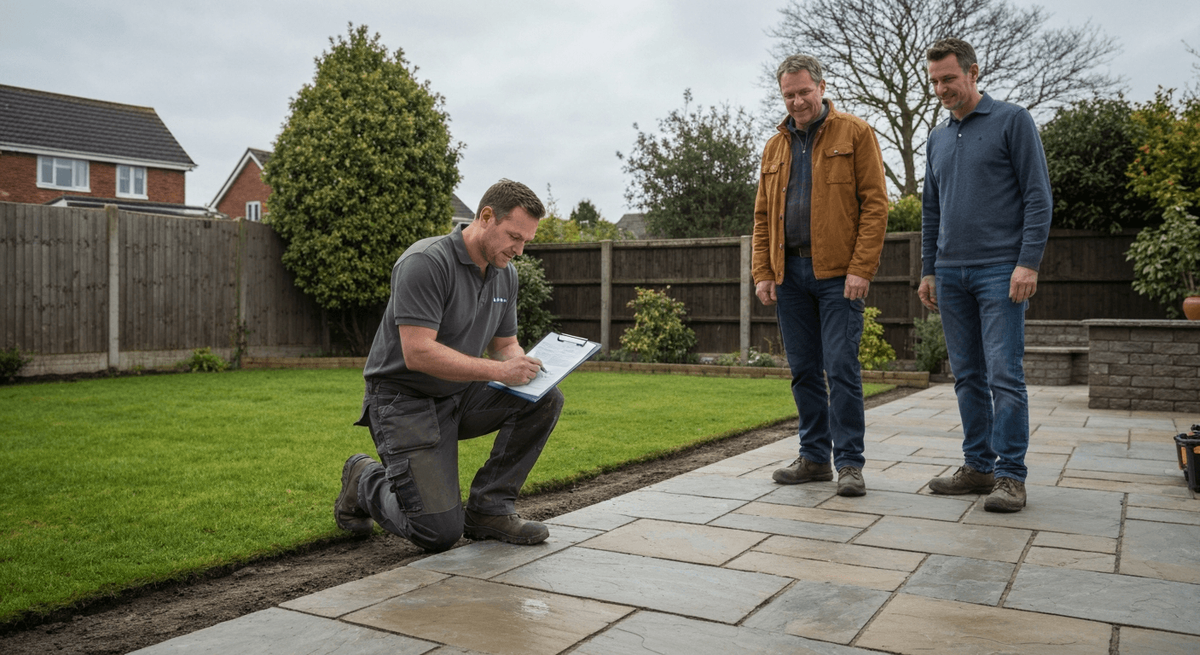
You quoted for a garden transformation last Tuesday. Decent job, good margin, exactly the kind of work you want. You spent an hour measuring up, another hour putting the quote together that evening, and sent it across the next morning. By the time it landed, the homeowner had already accepted a quote from someone else. Not because their price was better. Because they got there first.
This happens more often than most landscapers realise. The UK landscaping industry is worth £7.7 billion in 2026 according to IBISWorld, with nearly 25,000 businesses competing for work. In a market that crowded, the difference between winning and losing a job often comes down to something simpler than price or reputation. It comes down to how quickly you respond.
What a slow quote actually costs you
The numbers on this are striking. Research published by the Harvard Business Review, covering 2.24 million sales leads, found that companies who contacted a prospect within one hour of receiving an enquiry were nearly seven times more likely to qualify that lead than those who waited even sixty minutes longer. Wait twenty-four hours and you are sixty times less likely to have a meaningful conversation with that prospect.
For landscapers specifically, the financial impact is significant. Industry research from DigitalX Marketing found that UK tradespeople lose an average of £24,000 per year through missed or slow-responded calls alone. Nearly 62% of inbound calls to home service businesses go unanswered. If you are on site with a wheelbarrow in your hands, answering the phone is not always practical, but that does not change the outcome for the person trying to reach you.
Consider the maths on your own business. If your average landscaping job is worth £3,000 and you lose just two quotes a month to slower response times, that is £72,000 a year in revenue walking out the door. Even if only half of those would have converted, you are still looking at £36,000 in lost work annually. That is not a rounding error. That is a van, a piece of kit, or another pair of hands on your team.
Why landscapers are slow to quote (and why it is not really their fault)
The root cause is straightforward. Most landscaping businesses are run by one or two people who spend their days doing the actual work. You cannot lay a patio and write a quote at the same time. The work itself creates a bottleneck that pushes quoting to evenings and weekends.
There are a few patterns that make this worse. First, many landscapers still quote from scratch every time, building each estimate from a blank page rather than working from templates or standard pricing for common jobs. A simple fence replacement that could be quoted in ten minutes ends up taking forty-five because you are recalculating material costs and labour rates from first principles.
Second, site visits create delay. If every enquiry requires a physical visit before you can give any indication of price, you have added days to your response time before the quoting even starts. Some jobs genuinely need a site visit, but plenty of straightforward work like fencing, turfing, and basic paving can be ballparked from photos and measurements the customer provides.
Third, there is no system for tracking who has enquired, when, and whether they have had a response. Enquiries come in through phone calls, text messages, Facebook Messenger, emails, and website forms. Without a single place to see them all, things fall through the cracks. Research from Drift found that only 7% of companies respond to leads within five minutes, and 55% take five days or more. Landscapers are not uniquely bad at this. Most small businesses are.
What landscapers who win more work actually do differently
The businesses that consistently convert more quotes into jobs are not necessarily better landscapers. They are better at responding. Here is what the research shows they do.
They acknowledge enquiries immediately, even when they cannot quote straight away. A simple text or automated message that says "Thanks for getting in touch, I'll have a quote with you by tomorrow evening" does two things. It tells the customer you are professional and reliable, and it buys you time to put a proper quote together. According to research cited by Kixie, 78% of buyers go with the first company that responds to them. You do not need to quote in five minutes. You need to respond in five minutes.
They use standard pricing for repeatable jobs. If you lay artificial turf regularly, you should know your cost per square metre for materials, your labour rate, and your margin. That means a quote for a 40-square-metre lawn can be built in minutes rather than hours. The businesses that win four times as many contracts, according to SatQuote's research with UK landscapers, are the ones using estimating tools that turn a five-hour process into a one-hour process.
They give customers a reason to wait for them rather than calling the next person on the list. That means a fast initial response, a clear timeline for when the full quote will arrive, and a professional presentation when it does. Research from BrightLocal's 2026 consumer survey found that 80% of consumers are more likely to use a business that responds to every interaction. The bar is not perfection. The bar is showing up consistently.
They follow up. A quote sent is not a job won. The landscapers who convert more work check back two to three days after sending a quote. Not with a pushy sales call, but with a straightforward message: "Just checking you received the quote. Happy to answer any questions or adjust anything." That single follow-up can be the difference between a yes and a silence, because 85% of potential customers will not reach back out to you if they do not hear from you first, according to DigitalX Marketing's research.
Five things you can do this week to quote faster
These are not theoretical. They are practical changes you can make to your quoting process starting today.
1. Set up an automated response for new enquiries. Whether it comes through your website, Facebook, or a missed call, make sure every enquiry gets an instant acknowledgement. Most CRM tools, including TomCRM, can do this automatically. The message does not need to be long. "Thanks for your message. I'm currently on site but I'll get back to you with a quote by [specific time]" is enough. It keeps you in the race.
2. Build a pricing template for your five most common jobs. Work out your material costs, labour rate, and margin for the jobs you do most often: fencing, turfing, paving, decking, garden clearances. Save these as templates so you can adjust quantities rather than starting from scratch. If a 10-metre fence costs you a known amount in materials and takes a known number of hours, that calculation should not be happening from a blank page every time.
3. Ask for photos and measurements before booking a site visit. For straightforward jobs, a few photos and a rough measurement from the customer can tell you whether it is worth quoting and give you enough to provide a ballpark figure. Save the site visit for jobs where you genuinely need to see the ground conditions, access, or drainage.
4. Use a single inbox for all enquiries. If leads are coming in through four different channels and you are checking them at random, you will miss things. A CRM that pulls enquiries from your website, social media, and missed calls into one place means nothing gets lost. You can see at a glance who needs a response and who is waiting on a quote.
5. Set a follow-up reminder for every quote you send. Two to three days after sending a quote, check in. This is not about being pushy. It is about being professional. The landscaper who follows up is the one who gets the "actually yes, let's go ahead" reply that the others never receive.
The landscaper who responds wins the work
The UK landscaping market is competitive and getting more so every year. With nearly 25,000 businesses fighting for the same homeowners, the margins between winning and losing a job are thinner than you think. Price matters, reputation matters, quality of work matters. But none of those things matter if someone else has already been hired by the time your quote arrives.
The research is consistent on this point. Speed of response is one of the strongest predictors of whether a lead converts into a paying job. You do not need to be the cheapest. You do not need to be the flashiest. You need to be the one who shows up first, responds professionally, and follows through.
If your quoting process currently takes days, start by cutting it to hours. If it takes hours, aim for minutes on the initial response. That single change could be worth tens of thousands of pounds to your business over the next twelve months.