
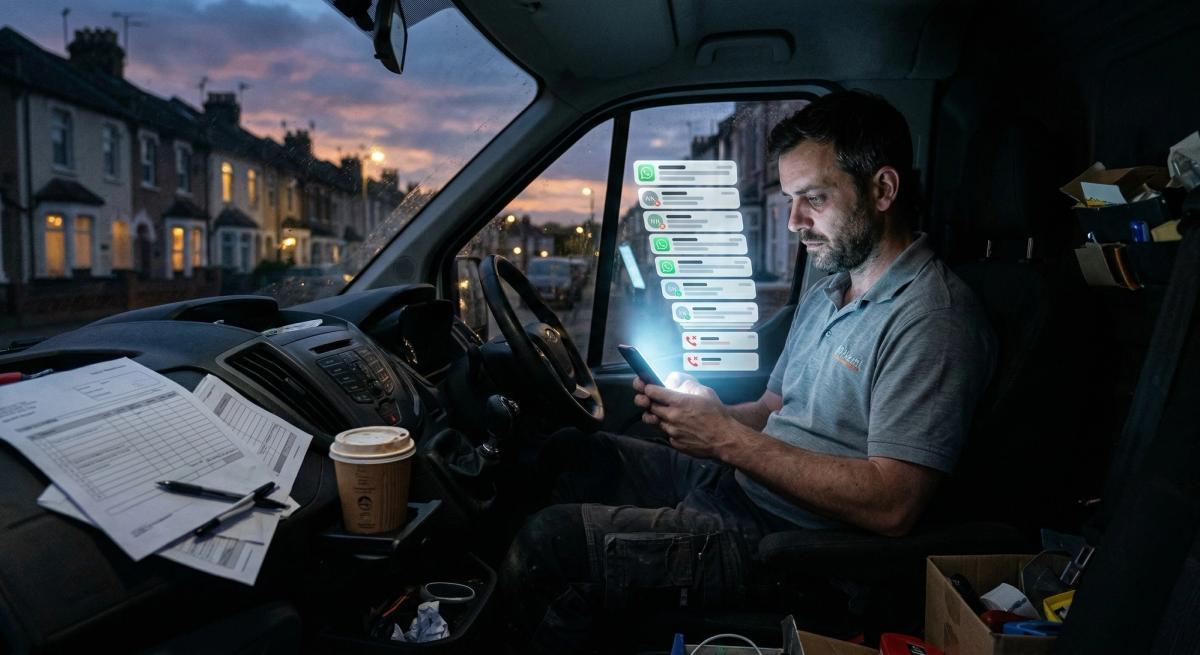
There is a pattern that repeats across almost every independent kitchen and bathroom installation business in the UK. A prospect calls or sends a WhatsApp message asking for a quote. The fitter is on site, hands deep in a worktop installation, and cannot respond immediately. They make a mental note to reply later. By the evening, they have had three more enquiries, two supplier calls, and a client wanting to change their tile selection. The mental note is forgotten. The prospect has already hired someone else.
This is not a technology problem. It is an infrastructure problem. And it is costing UK tradespeople thousands of pounds every year.
The current state of trade business admin
The numbers tell a clear story. According to 2025 data, 50% of UK micro-businesses (those with under 10 employees) do not use any dedicated CRM system. 32% still rely entirely on manual spreadsheets to manage customer data, quoting, and pipeline tracking. Only 27% of construction businesses use a CRM at all.
In the kitchen, bedroom, and bathroom (KBB) sector specifically, a 2025 industry survey found that 67% of respondents were sole traders and 33% limited companies, with 86% having 10 or more years in the industry. These are experienced, skilled professionals. But the same survey found that 81% do not subscribe to any lead generation platform, despite a quarter citing "fewer customers and enquiries" as their biggest business concern.
In the absence of purpose-built tools, the UK trade sector has overwhelmingly defaulted to WhatsApp as a makeshift CRM. It is convenient, free, and the homeowner is probably already using it. But as a business management tool, it is catastrophic.
Why WhatsApp is not a CRM
WhatsApp traps valuable leads in unstructured, unsearchable chat threads. There is no pipeline view. No way to see which leads need follow-up today. No automated reminders. No way to track which marketing channel generated which enquiry. No reporting on conversion rates, average response times, or revenue per lead source.
Business owners who rely on WhatsApp find themselves in an administrative loop every evening: re-reading chat threads, copying dimensions and specifications into a separate quoting tool, trying to remember which prospects they promised to call back, and hoping nothing has been missed.
It is ripe for human error. And in a market where the top reported business challenges are operating costs (26.6%) and fewer customers (24.7%), the businesses that fail to capture and convert their existing leads are compounding both problems simultaneously.
The "too busy to answer the £30,000 call" paradox
This is the central irony of the independent trades sector. The most skilled, most in-demand fitters are the ones most likely to miss calls and lose leads, precisely because they are busy doing the physical work. They are so consumed by the £8,000 bathroom job they are currently fitting that they miss the phone call offering a £30,000 bespoke kitchen.
The UK construction and trades industry faces a skills shortage requiring an estimated 239,300 extra workers by 2029. 35% of active tradespeople are over 50 and approaching retirement. This creates a powerful "seller's market" where highly skilled fitters have the leverage to choose their clients. But without administrative infrastructure, they frequently miss the most lucrative opportunities because they simply cannot get to the phone.
The gap between the quality of the work and the quality of the business systems is the single biggest constraint on growth for independent KBB installers.
What "better systems" actually look like
The businesses that grow fastest in this sector are not necessarily the best craftspeople. They are the ones that have separated the administrative function from the physical work. Here is what that looks like in practice.
Every lead lands in one place. Whether it comes from a phone call, a WhatsApp message, a website form, a Google Business Profile enquiry, or a Checkatrade listing, it goes into a single pipeline. No more checking three inboxes, a text thread, and a WhatsApp group. One view of every active lead, where it came from, and what needs to happen next.
Automated acknowledgement. When someone calls or messages and nobody answers, they get an immediate response: a text confirming the enquiry was received, an estimated callback time, and a link to book a site visit. This is not a cold auto-reply. It is a well-written, reassuring message that keeps the prospect engaged while the fitter finishes the job they are on.
Pipeline visibility. A CRM shows every lead in a clear pipeline: new enquiry, site visit booked, quote sent, quote followed up, job won, job in progress, job complete. The fitter can see at a glance which quotes are outstanding, which follow-ups are overdue, and which jobs need invoicing. Nothing falls through the cracks because nothing relies on memory.
Automated follow-up. If a quote is sent but not accepted within a few days, an automated message goes out: "Hi, just checking if you had any questions about the quote for your kitchen. Happy to talk through anything." Two follow-ups over a week. Then a final "closing the loop" message. Not aggressive sales. Just consistent, professional communication that prevents leads being lost to silence.
Automated review requests. When a job is marked as complete, the customer receives an automated SMS with a direct link to leave a Google review. No awkward conversation. No relying on the fitter to remember.
The case for structured systems
The evidence from businesses that have made this transition is consistent.
Bathroom and Kitchen Eleven, a UK KBB retailer, moved from disjointed spreadsheets and guesswork to a centralised CRM with automated enquiry intake. The result: they reduced their monthly marketing spend from £4,500 to £1,000 per month with no drop in overall sales revenue. The system showed them which advertising channels were producing revenue and which were not, allowing them to cut waste and focus spend where it worked.
HC Home Improvements implemented targeted Google Ads, landing pages, and a CRM with automated follow-ups. By removing the manual bottleneck of lead response, they generated over 436 high-quality leads and built a predictable pipeline of booked installations.
Businesses deploying automated call handling and review management have reported saving 5 to 15 hours per week in administrative labour and increasing total revenue by 10% to 25% simply by capturing leads that previously leaked to faster-responding competitors.
Why tradespeople resist (and why it matters less than they think)
The barriers to adopting a CRM are real but surmountable. 35% of UK businesses cite a lack of digital skills. 30% cite high initial costs. 25% point to uncertainty about return on investment.
For sole traders who spend 50 hours a week on physical installations, the idea of learning a new software platform feels impossible. And because most tradespeople do not systematically track their missed call rate or their lead-to-job conversion, the financial loss remains invisible. Without seeing the hidden £50,000 annual cost of missed calls and dropped leads, they cannot justify the visible £50 monthly cost of a CRM subscription.
But the tools available today are designed for exactly this profile: mobile-first, low-friction, and built to automate the boring administrative tasks that tradespeople do not have time for. The question is not whether you can afford a CRM. It is whether you can afford not to have one.
A four-week plan to get organised
You do not need to overhaul your business overnight. Here is a practical sequence that addresses the biggest problems first.
Week 1: Count your leads. Go through your phone, WhatsApp, email, and any platform inboxes for the last 30 days. How many enquiries came in? How many turned into site visits? How many turned into quotes? How many turned into jobs? If you cannot answer these questions, that is the first problem to solve.
Week 2: Set up a single inbox. Choose a CRM system and route every enquiry source into it. Phone calls, web forms, WhatsApp messages, platform leads. One place to see everything. This is the foundation that everything else builds on.
Week 3: Automate the first response. Configure a missed-call text-back and an auto-acknowledgement for web enquiries. Ensure that no prospect ever contacts your business and hears silence. This alone will recover a significant percentage of lost leads.
Week 4: Automate your follow-ups. Set up a simple sequence for sent quotes: a check-in after three days, a follow-up after a week, and a close-the-loop message after two weeks. Then set up an automated review request triggered by job completion.
If you want to see where your business stands on lead capture, response speed, and customer follow-up, our free assessment takes two minutes. Ten questions, an instant report, and specific recommendations for where to focus your effort.