
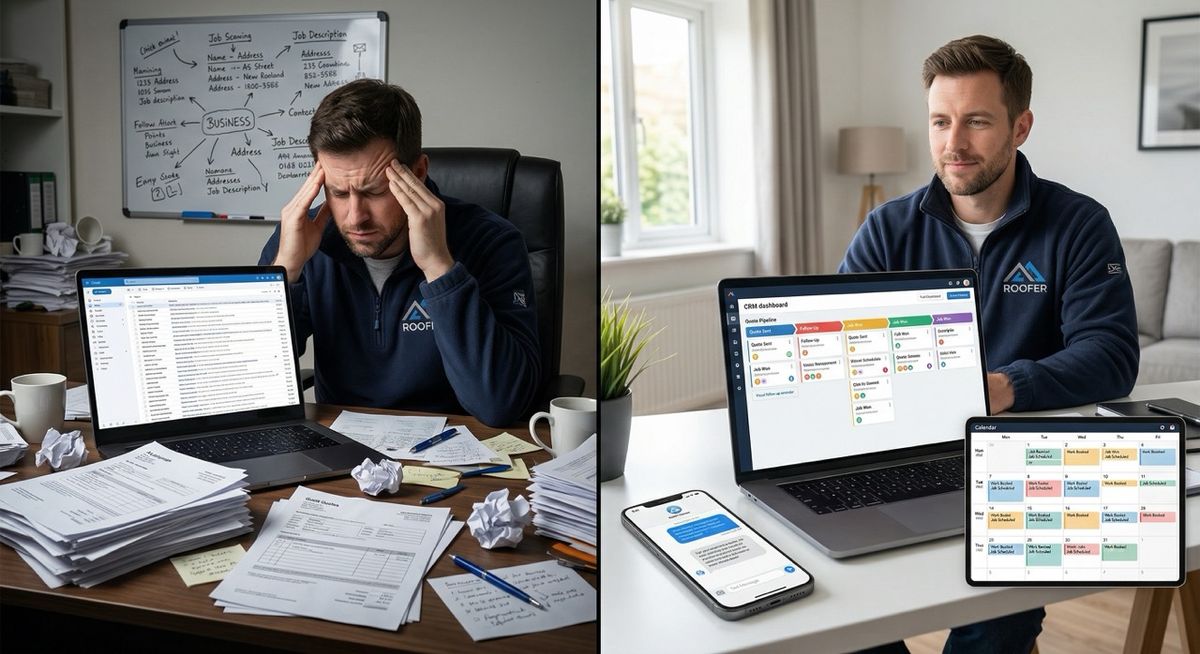
You drove to the property, spent an hour inspecting the roof, wrote up a detailed quote, and emailed it over. Then you waited. A week passed. Then two. The homeowner went quiet, and eventually you assumed they had gone with someone else.
That assumption is often wrong. In many cases, the customer has not chosen another roofer. They have not made any decision at all. They are sitting on three quotes, waiting for someone to make the next move. If none of the three roofers follows up, the homeowner often does nothing, sometimes for months.
The Gemini research report on UK roofing (2026) describes this as "the quote follow-up chasm." It is one of the largest and most avoidable sources of revenue loss in the entire sector.
What the conversion numbers actually look like
Across the broader UK home improvement and trades sector, the typical lead-to-sale conversion rate stands at approximately one secured order for every 3.5 quotes issued, a close rate of roughly 28%. Within roofing specifically, a "good" closing rate is generally accepted to sit between 30% and 40%, according to industry analysis cited in the Gemini research (2026).
If you are consistently closing above 50% on your own leads, that points to a tight sales process and strong local reputation. Though as the research notes, rates significantly above 50% may actually signal that you are underpricing your work, winning easily but leaving profit on the table with every job.
Conversely, close rates below 20% point to structural problems: either your leads are poor quality, or (far more commonly) there is no systematic follow-up happening after the quote goes out.
Why the decision takes so long
The timeline from issuing a roofing quote to getting the go-ahead is longer than most roofers expect. For standard domestic re-roofs, while the physical installation might take 1 to 5 days, the average waiting period from first contact to project start spans 2 to 3 weeks. For heritage or conservation projects requiring specialist materials and planning approvals, that extends to 10 to 12 weeks.
During this period, the homeowner is doing several things at once. They are comparing quotes, working out how to pay for the work (re-roofs are often financed through remortgages or personal loans), researching materials they do not fully understand, and managing the disruption that scaffolding and building work brings to a household. The Federation of Master Builders warns homeowners to expect waits of at least four months for a quality builder to become available, which gives some indication of the decision timescale customers are already operating within.
None of this is quick. And in a manual environment, as the Gemini research puts it, "contractors frequently adopt a highly passive stance after sending a PDF estimate via email, operating under the flawed assumption that an interested customer will naturally initiate contact to proceed."
That passivity is the problem. Without consistent follow-up to answer technical questions and reassure the buyer, you become commoditised. The homeowner stops comparing value and reliability and starts comparing price, because price is the only differentiator left when all three roofers have gone silent.
The speed-to-follow-up data is clear
Sales research consistently shows that the window for effective follow-up is far shorter than most people assume. Data cited across multiple lead management studies indicates that responding to a lead within five minutes versus waiting thirty minutes makes a business 21 times more likely to qualify that lead. Overall conversion likelihood increases by up to 400% when follow-up happens within that window.
For roofing, the relevant speed is not just the initial response (covered in Post 1) but the follow-up after the quote. If a £9,000 re-roof quote sits in someone's inbox for a week with no follow-up, the homeowner's motivation cools. Other priorities take over. The quote gets buried under 50 other emails. By the time you think to check in, the psychological momentum has gone.
What happens when follow-up is automated
The case study evidence is striking. The Gemini research (2026) documents a roofing business ("Samuel's Team") that had a healthy inbound lead pipeline but a stagnated close rate of just 18%. Leads were consistently slipping through due to slow responses, misplaced notes, and forgotten follow-ups.
After implementing CRM automation with structured follow-up sequences, the business saw its close rate surge from 18% to 37% within 90 days. Operating on the exact same inbound lead volume, they added approximately $380,000 (around £300,000) in annual revenue without spending an additional penny on advertising. The problem had never been lead generation. It was lead management.
A second case study, Legacy Contracting, was losing over 60 hours per month to manual admin: drafting quotes in Word documents, scheduling teams via text messages, and manually chasing clients for decisions. After implementing automated pipelines, they achieved a 31% revenue increase within 12 months (from $620,000 to $810,000), a 240% improvement in lead follow-up speed, and a 6% reduction in average sales cycle length.
The UK lead generation firm Leads 2 Trade reported similar results at scale. When they introduced structured follow-up and discounting capabilities to their installer network, aggregate conversion rates doubled from the industry standard of 1 in 3.5 to 1 in 1.4 (a 70% close rate). Businesses in that network were increasing turnover by 50% to 100% while maintaining average order values above £7,500.
What a practical follow-up system looks like
You do not need enterprise software or a sales team to fix this. A basic follow-up sequence for roofing quotes needs four touchpoints.
1. Same-day acknowledgement. After sending the quote, send a short text or email: "Hi [name], I have just sent over the quote for the [work type] at [address]. If you have any questions about the materials or the scope, just reply to this message and I will get straight back to you." This confirms receipt and opens a two-way channel.
2. 48-hour check-in. If the quote has not been accepted: "Just checking in on the quote I sent through for [address]. Happy to talk through anything, especially around the [specific technical detail, e.g. membrane options, tile choice, scaffold access]. No rush at all." This is not pushy. It is professional, and it differentiates you from the two roofers who sent a PDF and disappeared.
3. 7-day follow-up. "Hi [name], I know these decisions take time, especially with a [re-roof/flat roof replacement]. I have got availability in [month] if you wanted to pencil in a provisional start date. No commitment, just holds the slot." This introduces gentle urgency without pressure.
4. 14-day final follow-up. "Just a quick note that the pricing on the quote for [address] is valid until [date]. If anything has changed or you have decided to go a different route, no problem at all, just let me know so I can update my schedule." This closes the loop professionally.
A CRM system can automate all four of these touchpoints. Once the quote is sent and tagged in the system, the sequence runs without you needing to remember anything. You stay on the roof. The system follows up on the ground.
The compound effect on your business
Fixing your follow-up does not just win you more jobs from the same leads. It changes the economics of your entire operation.
If your current close rate is 25% on 10 quotes per month at an average job value of £6,000, you are doing £15,000 per month. Improving your close rate to 35% on the same leads, the same marketing spend, and the same number of site visits, takes that to £21,000 per month. That is £72,000 in additional annual revenue from a process change, not an advertising increase.
The Gemini research (2026) makes the broader point clearly: "The difference between an average, struggling local contractor and a dominant, highly profitable market leader is no longer defined solely by the quality of their physical installation. It is increasingly defined by the velocity, consistency, and technological maturity of their operational systems."
If you want to see where your quoting and follow-up process stands, our free roofing business assessment takes two minutes and shows you exactly where the leaks are.