
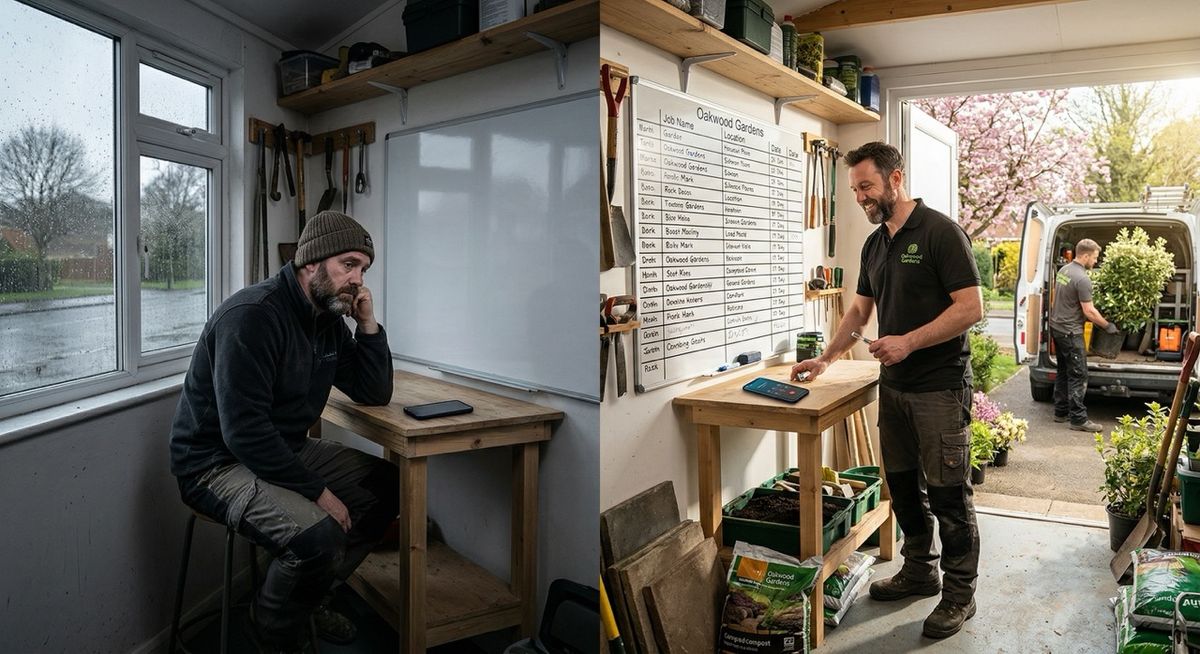
Every landscaper in the UK knows the pattern. Spring hits, the phone starts ringing, and suddenly you are booked solid through to September. Then October arrives, the enquiries slow, and by December you are wondering where the next job is coming from. By March, you are panic-marketing, saying yes to every job regardless of margin, and spending the summer catching up rather than choosing the work that actually pays well.
This cycle is not inevitable. It just feels that way because most landscaping businesses are structured to react to demand rather than create it.
The seasonality problem is a pipeline problem
The UK landscaping season runs roughly from late March through October. Daylight, soil conditions, frost risk, and the cultural urge to "sort the garden out for summer" push demand into a narrow window. UK-facing guidance for homeowners repeatedly states that spring is the busiest period for landscapers and that customers should book well in advance.
But the real commercial damage does not happen during the quiet months. It happens because of them. A winter with no pipeline leads to panic marketing in March, poor qualification ("say yes to everything"), and margin collapse through late spring as you try to catch up on lost ground.
IBISWorld reports 24,301 registered landscaping service businesses in the UK as of 2025, up 6.3% from the year before. That means more competition for the same spring rush. The businesses that stay booked year-round are not necessarily winning because they are better landscapers. They are winning because they filled their spring diary in January.
Your customers start looking in winter. Most landscapers are not there to be found.
This is the disconnect that costs businesses thousands every year. Homeowners do not wake up on the first warm Saturday in April and decide to get a new patio. They start researching in January.
Digital marketing data from landscaping sector campaigns shows that January produces the highest click-through rate of the entire calendar year at 6.98%, some 58% higher than the yearly average. Homeowners, often confined indoors after the holidays, spend this time researching local contractors, saving Instagram posts of finished gardens, and comparing quotes.
But January also has the lowest conversion rate of the year at just 4.26%. The homeowner is looking and clicking, but they are not ready to sign a contract while the ground is frozen. They are building a shortlist.
By April, the pattern inverts. The click-through rate drops back to the yearly average, but the conversion rate spikes to 10.3%, some 70% higher than average. The cost per lead in April drops to roughly £27, compared to £39 in January.
The critical point is this: the homeowner who converts in April is often the same person who clicked in January. If you were not there in January to capture their details, you will not be on their shortlist in April. They will call the landscaper whose website they bookmarked three months ago, not the one who starts advertising when the weather improves.
What "winter nurture" actually means in practice
Winter nurturing is not newsletters. It is a systematic way to capture leads during the research phase and keep your business front of mind until the homeowner is ready to commit.
The Harvard Business Review research on lead response, based on a study of 1.25 million sales leads, found that firms contacting a prospect within one hour were nearly seven times more likely to qualify that lead than those who waited longer. That principle applies in January just as much as it does in June. If a homeowner fills in your website form on a Tuesday evening in January, and you respond within minutes with a professional acknowledgement and a link to book a spring site visit, you have secured a position on their shortlist before your competitors have even noticed the enquiry.
From there, the nurture sequence does the work. A practical winter-to-spring sequence typically runs three to five automated emails over several weeks. The first provides immediate value: a seasonal preparation guide, or a gallery of recently completed projects similar to what the homeowner is considering. The second, sent a few days later, highlights a specific project with before-and-after photos, detailing the challenges overcome (poor drainage, tight access, uneven levels). The third addresses common objections: disruption, timelines, how the garden will look during construction. The fourth provides social proof: a selection of recent Google reviews and, if available, a short video from a satisfied client. The final email, timed for late February or early March, introduces scarcity: "Spring design slots are filling up. Book your free site visit before [date] to guarantee a summer completion."
Email marketing benchmarks for the landscaping sector show that top-performing companies achieve open rates as high as 38.7%, well above the industry average of 15.6%. The return on email marketing across industries is approximately £28 for every £1 spent. For a sequence that costs nothing beyond the initial setup time, the numbers are difficult to argue with.
The WhatsApp problem
There is a related issue that compounds the seasonality trap. Most small landscaping businesses manage their leads through a combination of WhatsApp messages, phone calls, texts, and memory. There is no single place where all enquiries land. There is no way to see which leads need follow-up, which quotes are outstanding, or which prospects from January are now ready to book.
When your leads live in WhatsApp threads, they are invisible. You cannot run a nurture sequence from WhatsApp. You cannot automate a follow-up. You cannot track which marketing channel generated which enquiry or calculate your conversion rate. You are relying entirely on memory, and memory does not scale.
Research shows that 80% of new leads generated across industries never convert into sales. The reason is not that the leads were bad. It is that businesses give up following up too early. In landscaping, where a £15,000 garden project can require up to 34 separate touchpoints before the homeowner commits (according to cross-industry attribution data on high-value transactions), a single phone call followed by silence is not a sales process. It is a coin flip.
What the best operators do differently
The landscapers who stay booked year-round share a common operational discipline. They capture every enquiry in one place, regardless of channel. They respond within minutes, even if only with an automated acknowledgement. They run structured follow-up sequences that keep leads warm through the winter. They automate review requests so their Google profile grows with every completed job. And they use their winter months to build a portfolio of scheduled spring starts rather than waiting for the phone to ring.
A documented UK example is Envirocare, a commercial gardening and grounds maintenance firm that implemented BigChange's job management platform. They replaced four separate admin systems with one integrated system, reducing the time required to quote new work, report completed jobs, issue invoices, and respond to customer queries. They rolled the system out across a franchise network managing around 100 ground staff nationwide.
At the smaller end, N.C Fencing and Decking in Ayrshire implemented systematic online visibility and lead generation strategies specifically aimed at combating the quieter winter months. They achieved a 1,600% return on investment from their marketing spend by ensuring their digital presence captured leads year-round rather than only during peak season.
You do not need to be running 100 staff or spending thousands on marketing to apply the same principles. The core discipline is the same whether you are a sole trader or a team of ten: capture every lead, respond fast, follow up systematically, and use the quiet months to build the pipeline for the busy ones.
A four-week plan to break the cycle
Week 1: Count your leads. Go through your phone, WhatsApp, email, and any platform inboxes for the last 30 days. How many enquiries came in? How many turned into site visits? How many turned into quotes? How many turned into jobs? If you cannot answer these questions, that is the first problem to solve.
Week 2: Set up a single inbox. Choose a CRM system and route every enquiry source into it. Phone calls, web forms, WhatsApp messages, platform leads. One place to see everything. This is the foundation that everything else builds on.
Week 3: Automate the first response. Configure a missed-call text-back and an auto-acknowledgement for web enquiries. Make sure no prospect ever contacts your business and hears silence. This alone will recover a significant percentage of lost leads.
Week 4: Build a winter nurture sequence. Set up a simple email sequence (three to five messages over several weeks) for leads that do not convert immediately. The content should be helpful, not pushy: project galleries, preparation advice, answers to common questions, and a clear call to action to book a spring site visit.
If you want to see where your business stands on lead capture, response speed, and seasonal pipeline management, our free assessment takes two minutes. Ten questions, an instant report, and specific recommendations for where to focus your effort.